What N-Back Training Does Not Do, and What It Actually Does
Written and researched by the Studio âge web research team / Last reviewed: / Editorial policy
This article summarizes published research for general information. It is not diagnosis, treatment, or medical advice.
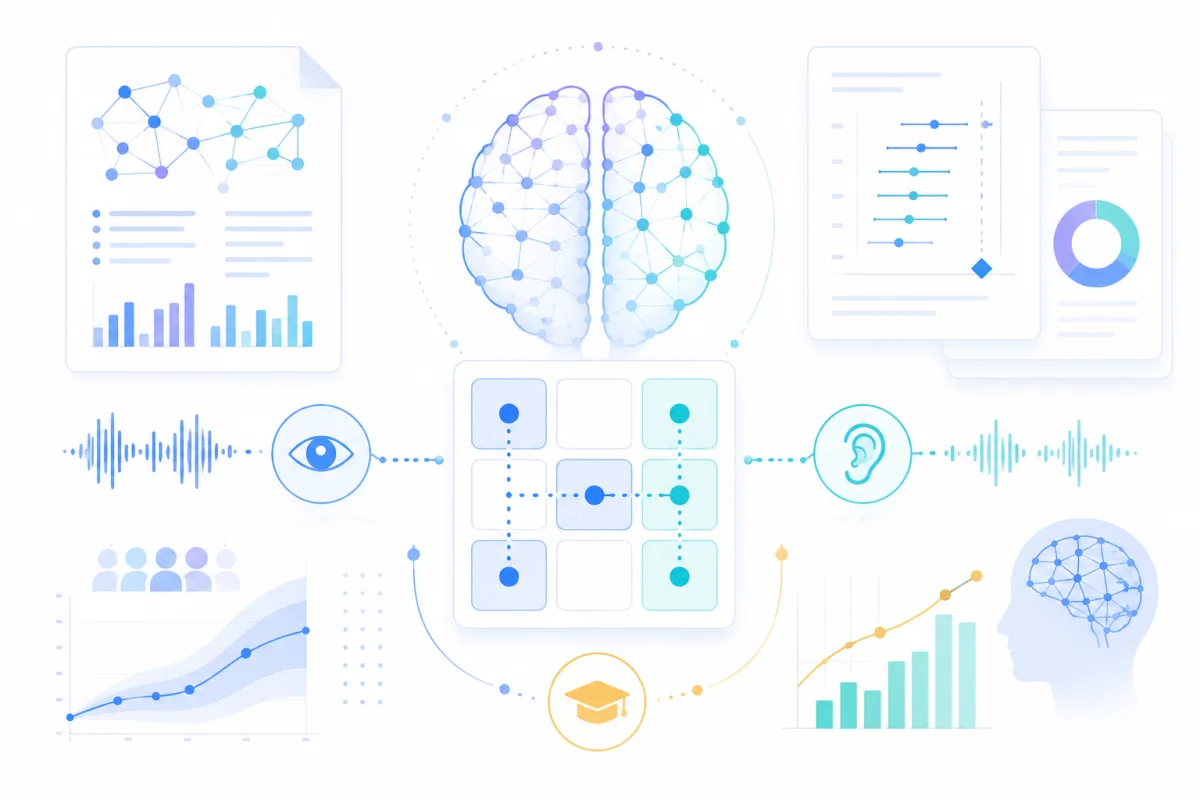
What N-Back Training Does Not Do, and What It Actually Does
"N-Back makes you smarter" and "brain training is useless" are both easy to find online. The short answer is that both are partly right and both are sloppy. The research shows that the benefits have a reach, and the edge of that reach is unusually well mapped.
This article sorts the replicated findings into three buckets: what does not work, what does, and what is still open. For a deeper treatment of the underlying mechanisms, see the review of near and far transfer.
In this article:
- Where N-Back training has been shown not to help
- Where the benefits do replicate
- What the effect sizes actually look like
- How to train in a way that matches the evidence
First: "effect" has four levels, not one
Most of the disagreement comes from people using one word for four different things. The literature usually distinguishes:
- Practice effect — you get better at the trained N-Back task itself
- Near transfer — untrained working memory tasks improve
- Far transfer — structurally different abilities improve, such as fluid intelligence, reasoning, or reading comprehension
- Ecological transfer — real-world outcomes improve: grades, work performance, symptoms
Almost every "brain training doesn't work" argument targets levels 3 and 4. It is not a claim about levels 1 and 2. Collapse the levels and both sides sound correct.
What N-Back training does not do
1. It does not reliably raise fluid intelligence
This is the famous dispute. Jaeggi et al. (2008) reported gains in fluid intelligence after N-Back training, and the brain-training industry grew out of that result. Rigorous replications and meta-analyses since then have pushed the far-transfer effect close to zero.
Soveri et al. pooled 203 effect sizes from 33 randomized controlled trials and found a medium-sized transfer to untrained N-Back tasks, but effects on fluid intelligence and cognitive control that were very small. Melby-Lervåg, Redick, and Hulme, analyzing 87 publications and 145 comparisons, found no convincing evidence of far transfer when training was compared against treated control groups. A 2024 second-order meta-analysis restricted to RCT-based reviews reached the same conclusion.
2. It does not demonstrably improve everyday performance
Level 4 — ecological transfer — is the hardest claim to support, and the evidence for it is the thinnest. There is no solid body of work showing that N-Back training improves academic or job performance. That is the main reason institutions such as the Stanford Center on Longevity stated that no scientific consensus supports broad cognitive improvement from brain training.
3. It does not do anything meaningful in a few days
The positive findings assume sustained training over weeks. On top of that, many transfer studies were substantially underpowered, which means small effects were measured with samples too small to measure them — a reliable way to make expectations look larger than the evidence.
What N-Back training does do
1. Performance on the trained task improves
Confirmed in essentially every study and not disputed. This is the part critics dismiss as "you just get better at the game," but it is a solid effect.
2. It transfers to untrained N-Back tasks
Soveri et al. found a medium-sized transfer to untrained N-Back tasks. Because performance carries over when the stimuli and format change, this is not simple memorization of a procedure.
3. It transfers to other working memory tasks — modestly
Structurally different working memory tasks improve by a small amount: g = 0.17 for verbal working memory and g = 0.24 for visuospatial working memory against active controls, and somewhat larger against passive controls. Not zero, not dramatic — that is the honest reading.
4. There is a route through which far transfer can occur
The picture is not purely negative. Pahor, Seitz, and Jaeggi (2022, *Nature Human Behaviour*) ran three RCTs totaling 460 participants and found that gains on untrained N-Back tasks mediated improvement in matrix reasoning, including in trials where the intervention itself produced no group-level effect. "Everyone who trains gains IQ" is dead; "people whose core task ability actually improved can see it show up in reasoning" is still standing. The effect disappears in the average and reappears in the individual differences.
The numbers
| Level | Example | Current verdict |
|---|---|---|
| Practice effect | The trained N-Back task | Reliable improvement (undisputed) |
| Near transfer | Untrained N-Back tasks | Medium-sized transfer |
| Near transfer | Other working memory tasks | Small (g ≈ 0.17–0.24) |
| Far transfer | Fluid intelligence, cognitive control | Very small / not supported |
| Ecological transfer | School, work, daily life | No established evidence |
As a rough guide, g around 0.2 is considered small and around 0.5 medium.
So is it worth doing?
Yes — but the reason has to change.
- "To raise my IQ" will not sustain you. With no evidence behind the goal, you get no confirmation of progress and plenty of reasons to quit.
- "To spend a few minutes a day loading working memory" fits the evidence. Near transfer replicates, and within that range the time is well spent.
- The measurement itself has value. A daily score taken the same way every day is a usable readout of your own state. Most people notice within a week how much a bad night of sleep costs them.
Put precisely: N-Back is not a general-purpose brain amplifier. It is a tool that applies measurable load to one specific function — working memory. Its specifications are clear, and used for what it is good at, it holds up.
FAQ
- Q. So is N-Back pointless?
-
Not pointless — bounded. The "it raises IQ" claim is largely rejected, while near transfer to working memory tasks replicates across meta-analyses and improvement on the task itself is certain.
- Q. If the effect is small, why bother?
-
Weigh it against the cost: 5–10 minutes a day buys a small but real effect plus a consistent daily measure of your own cognitive state.
- Q. How long does training need to run?
-
Most positive findings assume three to five sessions per week for four to eight weeks. A few days tells you nothing.
- Q. Is dual N-Back better?
-
It imposes a heavier cognitive load by combining visual and auditory streams, but there is no established finding that its far-transfer evidence is stronger than single N-Back. Difficulty and benefit are separate questions.
Know the reach of the effect, then apply a manageable load in short, regular sessions. That is the most defensible way to use this tool today.
▶ Start the free N-Back task now
References
- Soveri, A., Antfolk, J., Karlsson, L., Salo, B., & Laine, M. (2017). Working memory training revisited: A multi-level meta-analysis of n-back training studies. Psychonomic Bulletin & Review
- Melby-Lervåg, M., Redick, T. S., & Hulme, C. (2016). Working memory training does not improve performance on measures of intelligence or other measures of "far transfer": Evidence from a meta-analytic review. Perspectives on Psychological Science
- Pahor, A., Seitz, A. R., & Jaeggi, S. M. (2022). Near transfer to an unrelated N-back task mediates the effect of N-back working memory training on matrix reasoning. Nature Human Behaviour
- Redick, T. S., et al. (2015). Reliable gains? Evidence for substantially underpowered designs in studies of working memory training transfer to fluid intelligence. PMC