N-Back Difficulty Levels: Complete Guide
Written and researched by the Studio âge web research team / Last reviewed: / Editorial policy
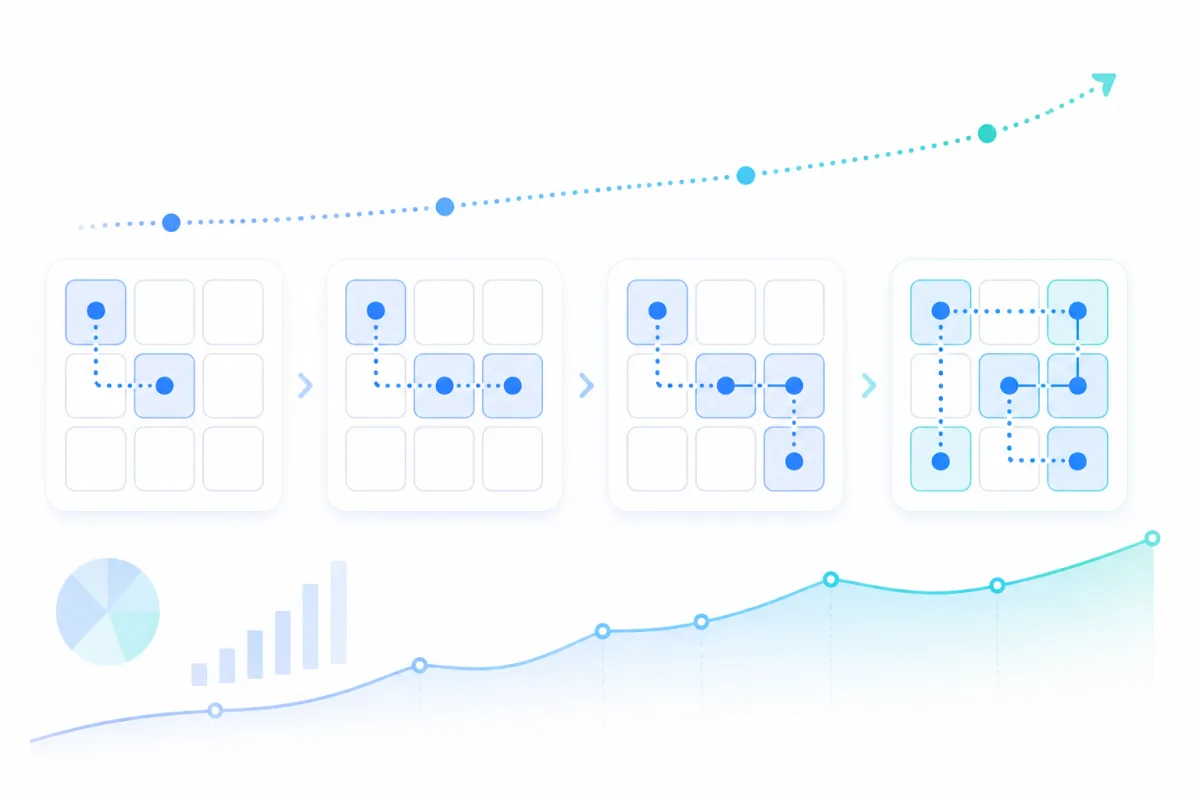
N-back difficulty is controlled by the number before "back." In a 1-back task, you compare the current stimulus with the one immediately before it. In a 2-back task, you compare it with the stimulus two steps earlier. As the number rises, you must hold more information in working memory and update it more carefully after every trial.
The best level is not always the highest one you can attempt. A useful n-back challenge should feel demanding but still playable. If accuracy collapses, the task turns into guessing. If accuracy is nearly perfect, the level may be too easy to create meaningful cognitive load.
This guide explains the common levels from 1-back through 5-back and beyond. Use the table as a practical reference, then read the level notes to decide where to begin, when to stay, and when to raise the difficulty.
| Level | Difficulty | Best for | Typical accuracy |
|---|---|---|---|
| 1-back | Easy | Beginners, warm-up, learning response timing | 80-95% once learned |
| 2-back | Moderate | Most users, standard practice, research-style baseline | 65-85% |
| 3-back | Hard | Experienced users who want a stronger challenge | 50-75% |
| 4-back | Advanced | High performers and serious training sessions | 40-70% |
| 5-back+ | Niche | Enthusiasts, self-experiments, very advanced play | Highly variable |
1-Back: beginner level and warm-up
In 1-back, the question is simple: is the current item the same as the immediately previous item? This level is useful when you are learning the rules, checking whether your keyboard or audio response feels natural, or warming up before harder rounds. It is also a reasonable choice when you are tired and want a lighter session.
If 1-back quickly feels automatic, do not stay there for every session. Use it to learn the rhythm, then move to 2-back when you can respond accurately without pausing to decode the instructions.
2-Back: the standard starting point
2-back is the most practical starting level for many users after they understand the task. It requires active updating, but it is not so difficult that most people are lost from the first round. Many research tasks use 2-back conditions because they create a measurable working memory load while remaining possible for typical participants.
If you searched for a "2 back task," this is the level to learn first. Stay here until your accuracy is stable across several sessions. The goal is not to memorize a trick, but to keep the sequence moving in your mind without relying on constant guessing.
3-Back: the major difficulty jump
3-back is where many users notice a real wall. You must keep a longer sequence active, ignore tempting near-matches, and update the remembered items after every new stimulus. Errors often happen when the brain grabs the one-back or two-back item instead of the correct three-back item.
This level is best for users who already score consistently at 2-back. If your 3-back accuracy drops very low, return to 2-back for a while and build speed, confidence, and consistency.
4-Back: advanced practice
4-back is an advanced level. It demands sustained attention, stable working memory updating, and tolerance for mistakes. In the influential Jaeggi et al. (2008) dual n-back training study, participants used adaptive difficulty and stronger performers could reach higher n-levels, including around 4-back. That does not mean beginners should start there.
Treat 4-back as a high-load training level. It is most useful after 3-back accuracy has become reasonably stable and you can handle errors without losing the whole sequence.
5-Back and beyond
5-back and higher levels are niche. They can be interesting for enthusiasts who enjoy pushing the task, but they are not necessary for most training goals. At very high levels, performance can depend heavily on strategy, rhythm, and patience. If accuracy is extremely low, a lower level will usually provide better practice.
When to advance
A simple rule is to advance when your accuracy is around 80% or higher for several sessions. Do not move up after one lucky round. Look for stable performance. If your score drops sharply at the next level, switch back and rebuild consistency.
Adaptive difficulty works best when the task is hard enough to require effort but easy enough that you can still learn. For most people, that means spending meaningful time at 2-back and 3-back before using 4-back regularly.
Dual n-back at each level
Dual n-back is harder because it asks you to track two streams at the same time, usually visual position and auditory information. A 2-back dual task can feel much harder than a 2-back single task. If you are new to dual training, reduce the n-level first and build from there. Learn more in the dual n-back guide.
Start at your level
Start with the lowest level that feels meaningfully challenging. Beginners can use 1-back to learn the rules, most users can build skill at 2-back, and advanced users can test themselves at 3-back or 4-back.