Dual N-Back: How It Works and How to Start
Written and researched by the Studio âge web research team / Last reviewed: / Editorial policy
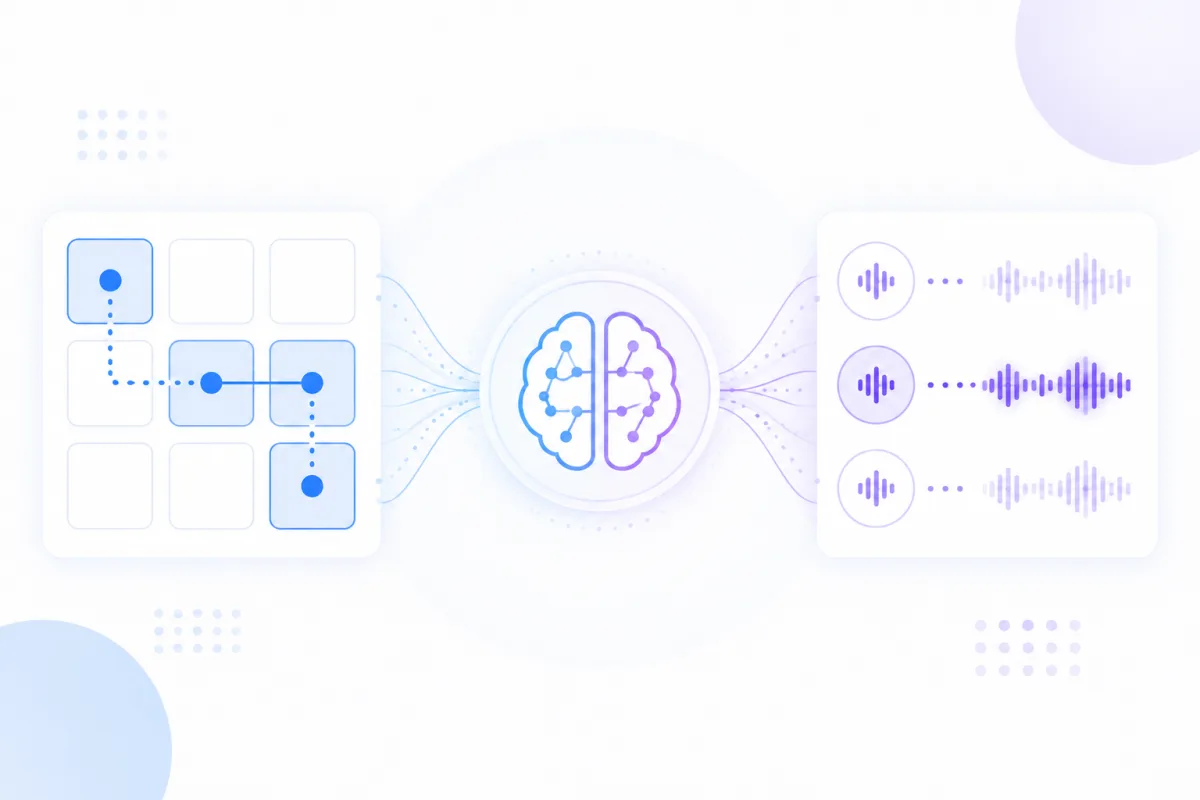
Dual n-back is a working-memory task that asks you to monitor two changing streams at the same time. A common version flashes a square in one position on a grid while playing a spoken letter. You respond when the current position matches the position from N trials earlier, when the current sound matches the sound from N trials earlier, or when both match. Each stream has its own decision, so success depends on maintaining and updating two short sequences without mixing them together.
How dual n-back differs from single n-back
The browser game on this site currently uses a single visual stream. That format is the clearest place to learn the n-back rule: compare the current position with the position from one, two, or more trials earlier. Dual n-back adds a second stream, normally sound, but it does not change the underlying rule. It increases the demand because attention must move between two streams while each sequence is updated independently.
This distinction matters when comparing scores. An 80% score on visual 2-back is not directly comparable with an 80% score on dual 2-back. Dual tasks contain more possible target types and more opportunities to miss or make a false alarm. Track visual and auditory accuracy separately when the software provides those measurements.
A simple dual 2-back example
Imagine that each trial shows a grid position and plays a letter. On trial five, the square may repeat the position shown on trial three while the letter is different. That is a visual match only. On another trial, the letter may match two trials earlier while the position does not. You press the auditory response only. If both repeat, you make both responses. If neither repeats, you wait for the next trial.
Why the task feels difficult
The difficulty is not only the number of items held in memory. You must discard information that has moved outside the N-back window, add the new pair of stimuli, preserve the order of both streams, and make two match decisions before the next trial. Focusing too strongly on the grid can make the sound sequence disappear; focusing on the letters can cause missed visual matches. Lower accuracy is therefore normal when moving from a single task to a dual task at the same N level.
What research does and does not show
Dual n-back became widely known after Jaeggi and colleagues reported in 2008 that adaptive working-memory training transferred to fluid-intelligence tests. Later research produced a more cautious picture. Practice reliably improves the practiced n-back task, and transfer is more plausible for closely related working-memory tasks. Evidence for broad improvements in general intelligence, school performance, or everyday productivity is mixed and usually smaller. Read our review of dual n-back and IQ and our working-memory transfer review for the evidence and limitations.
How beginners should progress
- Learn the timing and match rule with visual 1-back.
- Move to visual 2-back after accuracy is stable across several sessions.
- Begin dual 1-back so the second response does not arrive at the same time as a large N increase.
- Try dual 2-back only after you can track both streams without guessing.
- Reduce the level or shorten the session when false alarms rise sharply.
Accuracy is more useful than chasing the highest possible level. A task that is nearly impossible mainly measures guessing and frustration. A practical session should remain demanding while still producing enough correct decisions to reveal whether performance is improving.
Start with the visual browser game
Use the free visual game to learn the core rule before adding an auditory stream. It works in a modern browser without installation or registration and provides levels from 1-back through 6-back. The game is a training and self-observation tool, not a medical test or treatment.
References
- Jaeggi, S. M., Buschkuehl, M., Jonides, J., & Perrig, W. J. (2008). Improving fluid intelligence with training on working memory. PNAS, 105(19), 6829–6833. https://doi.org/10.1073/pnas.0801268105
- Soveri, A., Antfolk, J., Karlsson, L., Salo, B., & Laine, M. (2017). Working memory training revisited: A multi-level meta-analysis of n-back training studies. Psychonomic Bulletin & Review, 24, 1077–1096. https://doi.org/10.3758/s13423-016-1217-0